
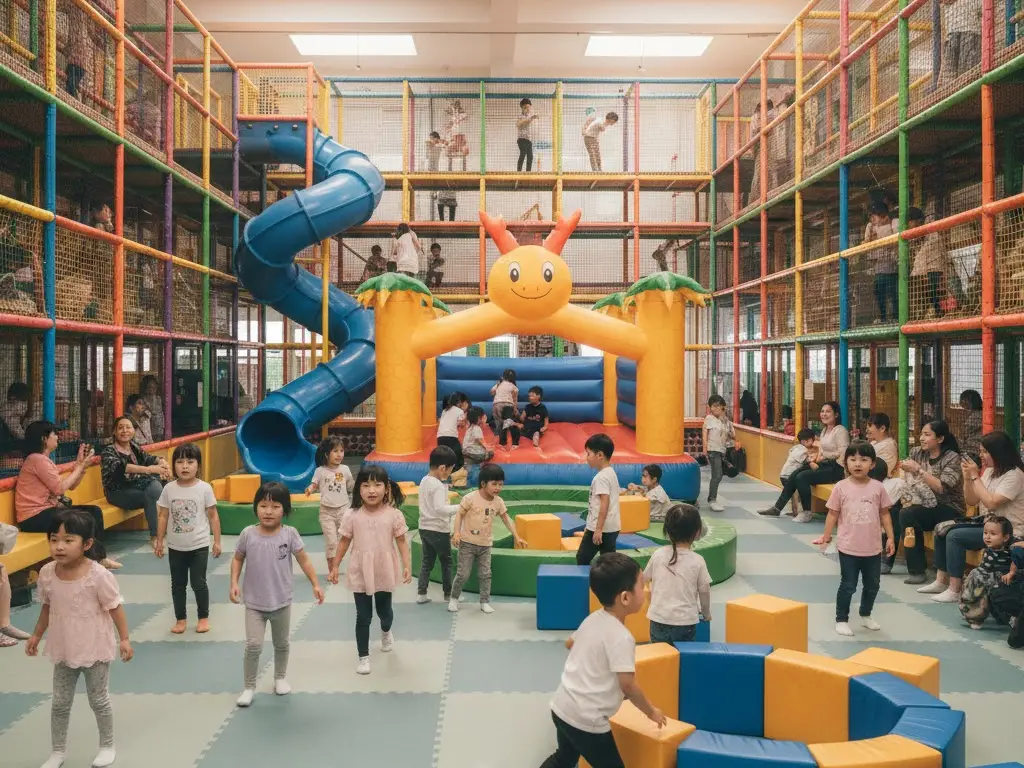
As parents, we often think of indoor playgrounds as simply a fun way to burn off energy on a rainy day. But those multi-story climbing structures, twisty slides, and elaborate obstacle courses are more than just entertainment, they are incredible laboratories for brain development.
Unstructured, active play is one of the most powerful tools for building the cognitive skills your child needs for school and life. Here are seven scientifically-backed ways that a simple trip to the indoor playground turns into a powerful brain-boosting workout.
1. Enhances Spatial Awareness and Cognitive Mapping
When your child enters a massive indoor playground, their brain immediately gets to work creating a cognitive map. They must constantly calculate where their body is in relation to the walls, nets, and slides.
The Play Action: Navigating the complex layout, finding the correct tunnel exit, and determining the distance before jumping.
The Brain Benefit: This intensive practice strengthens spatial reasoning and depth perception. These skills are foundational for later success in mathematics (especially geometry), reading maps, and even understanding complex physics concepts.
2. Develops Crucial Executive Functioning Skills
Executive functioning is the set of mental skills that includes working memory, flexible thinking, and self-control. The playground is a low-stakes environment to practice these skills.
The Play Action: Setting a goal (“I want to climb to the top slide”), planning the route, and managing the inevitable challenge (like a blockage or a tricky climb).
The Brain Benefit: By planning their ascent and sequencing the steps required to get there, children are intensely practicing planning, organization, and working memory.
3. Fosters Smart Risk Assessment and Confidence
While they are inherently safe, indoor playgrounds feel like a major adventure to a child. Successfully facing those perceived challenges is key to building self-efficacy.
The Play Action: Standing at the top of a very tall drop slide, or deciding to attempt a challenging, wobbly bridge.
The Brain Benefit: Children practice calculated risk assessment. They look at the challenge, gauge their physical limits, and decide whether to proceed. Successfully mastering a physical feat triggers the release of feel-good hormones, reinforcing confidence and the motivation to take on new cognitive challenges in the classroom.
4. Sharpens Problem-Solving and Creative Thinking
Unlike structured games with fixed rules, a playground allows kids to define the fun. When they run into an obstacle, they must instantly pivot their strategy.
The Play Action: Encountering a crowded section, finding an unexpected dead-end, or using a feature in a new, creative way (like using a slide tunnel as a pretend spaceship).
The Brain Benefit: The brain is constantly engaging in divergent thinking—the ability to generate multiple solutions to a single problem. This is a hallmark of creativity and critical thinking.
5. Integrates Bilateral Coordination and Motor Planning
The most challenging playground elements require the two hemispheres of the brain to work together seamlessly.
The Play Action: Climbing a rope ladder, crawling through a fabric tube, or maneuvering across a balance beam.
The Brain Benefit: These movements strengthen bilateral coordination (using both sides of the body together). More importantly, the child develops motor planning—the cognitive ability to conceive, plan, and execute a new physical task. This integration is vital for later fine motor skills like writing and using scissors.
6. Boosts Language and Communication Skills
Playgrounds are social melting pots where children from different backgrounds and ages must interact, often without parental intervention.
The Play Action: Negotiating who gets to go next, engaging in spontaneous role-play, or asking a new friend to join a game.
The Brain Benefit: Children are forced to articulate their thoughts, listen to social cues, and practice conflict resolution and negotiation. This builds complex communication skills and emotional literacy.
7. Supports Emotional Regulation Through Sensory Input
Running and jumping aren’t just about burning calories; they are essential for regulating the nervous system.
The Play Action: Jumping wildly on a trampoline area, swinging, or rolling through the ball pit (which provides deep pressure input).
The Brain Benefit: Vigorous physical activity provides intense proprioceptive (body position) and vestibular (movement/balance) sensory input. This “organizes” the nervous system, helping children manage high energy, reduce stress, and transition to a calmer, more focused state needed for concentration later.
Next time you visit an indoor playground, look beyond the chaos. You aren’t just paying for an hour of fun; you’re investing in a powerful developmental workout that strengthens your child’s brain, one climb and one jump at a time. Encourage them to try new things and let them lead the way!
Time to let your kids discover the world through play!
1. Giggle Jungle by Yooland
What sets Giggle Jungle apart is its impressive size, high ceilings, and diverse array of activities that appeal even to older children who might find smaller playgrounds less challenging.
| Address | 180 Kitchener Rd, #04-38 City Square Mall, Singapore 208539 |
| Phone | 89557098 |
| Website | http://yooland.sg/ |
2. Kiztopia
Singapore’s largest indoor playground, featuring 18 diverse play zones including two-story slides, mega ball pits, and various role-play rooms. Great for developing social skills and physical endurance.
| Address | Multiple locations |
| Phone | – |
| Website | https://kiztopia.com/ |
3. SuperPark Singapore
An all-in-one activity park spanning two floors, perfect for older kids, teens, and adults. Features include obstacle courses, climbing walls, a trampoline arena, and new game stations, focusing on friendly competition, agility, and gross motor skills.
| Address | 3 Temasek Blvd, #01-488 Suntec City Mall, Singapore 038983 |
| Phone | 62395360 |
| Website | http://www.superpark.com.sg/ |
4. Buds by Shangri-La
A premium, massive space (over 1,800 sq metres) that features extensive play equipment, a specific toddler zone, and themed areas like a sand play zone and an immersive studio for music and art, fostering creativity and sensory development.
| Address | 22 Orange Grove Rd, Singapore 258350 |
| Phone | 62134833 |
| Website | http://www.shangri-la.com/singapore/shangrila/for-kids/buds-by-shangri-la/ |
5. Tayo Station
Themed after the popular Korean animated series Tayo The Little Bus. Its signature attraction is Tayo’s Road Circuit, a street where children can drive mini-cars, offering fun learning about road safety and traffic rules.
| Address | 1 Pasir Ris Cl, #03-112 E!Hub @ Downtown East, Singapore 519599 |
| Phone | 62395360 |
| Website | http://www.tayostation.com/ |
6. Pororo Park Singapore
Themed around Pororo the Little Penguin, this playground is ideal for families with younger children (up to age 12). Highlights include the Pororo Express Train, Petty’s Supermarket for pretend play, a wood-chip pit, and daily character appearances.
| Address | Raffles Blvd, Marina Square, Singapore 039594 |
| Phone | 62395360 |
| Website | http://www.pororoparksg.com/ |
7. Adventure HQ
Designed for adventure seekers and older kids, this facility spans four stories and features challenging, adrenaline-pumping activities. It includes Singapore’s first indoor roll glider, a 14-meter indoor slide, and extensive high-element courses, focusing on courage and risk assessment.
| Address | 2 Yishun Walk, Singapore 767944 |
| Phone | 67059420 |
| Website | https://www.hometeamns.sg/khatib/adventurehq/ |
8. AIRZONE
A unique, entirely suspended indoor net playground strung up across several levels of the mall. Children (and adults) bounce, climb, and crawl through an elevated maze of nets, promoting spatial awareness, core strength, and balance in a novel environment.
| Address | 180 Kitchener Road, #02-K4, K10, 208539 |
| Phone | 66319789 |
| Website | http://www.airzone.sg/ |